
• Home
  • Latest
  • Fortune 500
  • Finance
  • Tech
  • Leadership
  • Lifestyle
  • Rankings
  • Multimedia
TechAI

Google CEO Sundar Pichai says ‘hallucination problems’ still plague A.I. tech and he doesn’t know why

Will Daniel
By
Will Daniel
Will Daniel
Down Arrow Button Icon
Will Daniel
By
Will Daniel
Will Daniel
Down Arrow Button Icon
April 17, 2023, 1:37 PM ET
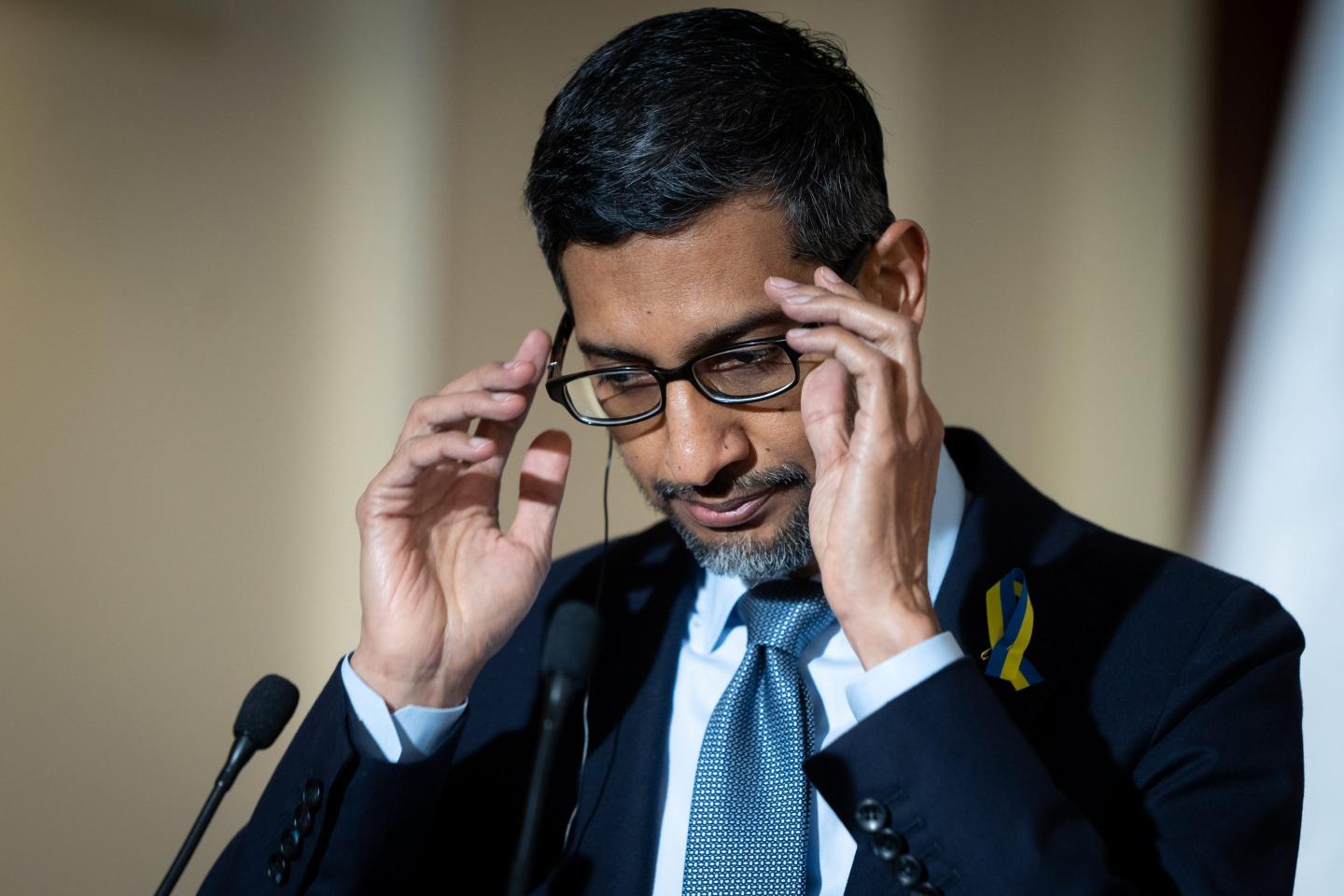
CEO of Google's parent company Alphabet Sundar Pichai.
CEO of Google's parent company Alphabet Sundar Pichai.Mateusz Wlodarczyk—NurPhoto/Getty Images

Google’s new chatbot, Bard, is part of a revolutionary wave of artificial intelligence (A.I.) being developed that can rapidly generate anything from an essay on William Shakespeare to rap lyrics in the style of DMX. But Bard and all of its chatbot peers still have at least one serious problem—they sometimes make stuff up.

Recommended Video

The latest evidence of this unwelcome tendency was displayed during CBS’ 60 Minutes on Sunday. The Inflation Wars: A Modern History by Peter Temin “provides a history of inflation in the United States” and discusses the policies that have been used to control it, Bard confidently declared during the report. The problem is the book doesn’t exist. 

It’s an interesting lie by Bard—because it could be true. Temin is an accomplished MIT economist who studies inflation and has written over a dozen books on economics, he just never wrote one called The Inflation Wars: A Modern History. Bard “hallucinated” that, as well as names and summaries for a whole list of other economics books in response to a question about inflation. 

It’s not the first public error the chatbot has made. When Bard was released in March to counter OpenAI’s rival ChatGPT, it claimed in a public demonstration that the James Webb Space Telescope was the first to capture an image of an exoplanet in 2005, but the aptly named Very Large Telescope had actually accomplished the task a year earlier in Chile.

Chatbots like Bard and ChatGPT use large language models, or LLMs, that leverage billions of data points to predict the next word in a string of text. This method of so-called generative A.I. tends to produce hallucinations in which the models generate text that appears plausible, yet isn’t factual. But with all the work being done on LLMs, are these types of hallucinations still common?

“Yes,” Google CEO Sundar Pichai admitted in his 60 Minutes interview Sunday, saying they’re “expected.” “No one in the field has yet solved the hallucination problems. All models do have this as an issue.”

When asked if the hallucination problem will be solved in the future, Pichai noted “it’s a matter of intense debate,” but said he thinks his team will eventually “make progress.”

That progress may be difficult to come by, as some A.I. experts have noted, due to the complex nature of A.I. systems. Pichai explained that there are still parts of A.I. technology that his engineers “don’t fully understand.”

“There is an aspect of this which we call—all of us in the field—call it a ‘black box,’” he said. “And you can’t quite tell why it said this, or why it got it wrong.”

Pichai said his engineers “have some ideas” about how their chatbot works, and their ability to understand the model is improving. “But that’s where the state of the art is,” he noted. That answer may not be good enough for some critics who warn about potential unintended consequences of complex A.I. systems, however.

Microsoft cofounder Bill Gates, for example, argued in March that the development of A.I. tech could exacerbate wealth inequality globally. “Market forces won’t naturally produce AI products and services that help the poorest,” the billionaire wrote in a blog post. “The opposite is more likely.” 

And Elon Musk has been sounding the alarm about the dangers of A.I. for months now, arguing the technology will hit the economy “like an asteroid.” The Tesla and Twitter CEO was part of a group of more than 1,100 CEOs, technologists, and A.I. researchers who called for a six-month pause on developing A.I. tools last month—even though he was busy creating his own rival A.I. startup behind the scenes.

A.I. systems could also exacerbate the flood of misinformation through the creation of deep fakes—hoax images of events or people created by A.I.—and even harm the environment, according to researchers surveyed in an annual report on the technology by Stanford University’s Institute for Human-Centered A.I., who warned the threat amounts to a potential “nuclear-level catastrophe” last week.

On Sunday, Google’s Pichai revealed he shares some of the researchers’ concerns, arguing A.I. “can be very harmful” if deployed improperly. “We don’t have all the answers there yet—and the technology is moving fast. So does that keep me up at night? Absolutely,” he said.

Pichai added that the development of A.I. systems should include “not just engineers, but social scientists, ethicists, philosophers, and so on” to ensure the outcome benefits everyone.

“I think these are all things society needs to figure out as we move along. It’s not for a company to decide,” he said.

Join us at the Fortune Workplace Innovation Summit May 19–20, 2026, in Atlanta. The next era of workplace innovation is here—and the old playbook is being rewritten. At this exclusive, high-energy event, the world’s most innovative leaders will convene to explore how AI, humanity, and strategy converge to redefine, again, the future of work. Register now.
About the Author
Will Daniel
By Will Daniel
LinkedIn iconTwitter icon
See full bioRight Arrow Button Icon

Latest in Tech

InvestingStock
There have been head fakes before, but this time may be different as the latest stock rotation out of AI is just getting started, analysts say
By Jason MaDecember 13, 2025
2 hours ago
Politicsdavid sacks
Can there be competency without conflict in Washington?
By Alyson ShontellDecember 13, 2025
2 hours ago
InnovationRobots
Even in Silicon Valley, skepticism looms over robots, while ‘China has certainly a lot more momentum on humanoids’
By Matt O'Brien and The Associated PressDecember 13, 2025
4 hours ago
Sarandos
Arts & EntertainmentM&A
It’s a sequel, it’s a remake, it’s a reboot: Lawyers grow wistful for old corporate rumbles as Paramount, Netflix fight for Warner
By Nick LichtenbergDecember 13, 2025
9 hours ago
Oracle chairman of the board and chief technology officer Larry Ellison delivers a keynote address during the 2019 Oracle OpenWorld on September 16, 2019 in San Francisco, California.
AIOracle
Oracle’s collapsing stock shows the AI boom is running into two hard limits: physics and debt markets
By Eva RoytburgDecember 13, 2025
10 hours ago
robots
InnovationRobots
‘The question is really just how long it will take’: Over 2,000 gather at Humanoids Summit to meet the robots who may take their jobs someday
By Matt O'Brien and The Associated PressDecember 12, 2025
23 hours ago

Most Popular

placeholder alt text
Economy
Tariffs are taxes and they were used to finance the federal government until the 1913 income tax. A top economist breaks it down
By Kent JonesDecember 12, 2025
1 day ago
placeholder alt text
Success
Apple cofounder Ronald Wayne sold his 10% stake for $800 in 1976—today it’d be worth up to $400 billion
By Preston ForeDecember 12, 2025
1 day ago
placeholder alt text
Success
40% of Stanford undergrads receive disability accommodations—but it’s become a college-wide phenomenon as Gen Z try to succeed in the current climate
By Preston ForeDecember 12, 2025
1 day ago
placeholder alt text
Economy
The Fed just ‘Trump-proofed’ itself with a unanimous move to preempt a potential leadership shake-up
By Jason MaDecember 12, 2025
22 hours ago
placeholder alt text
Economy
For the first time since Trump’s tariff rollout, import tax revenue has fallen, threatening his lofty plans to slash the $38 trillion national debt
By Sasha RogelbergDecember 12, 2025
24 hours ago
placeholder alt text
Success
Apple CEO Tim Cook out-earns the average American’s salary in just 7 hours—to put that into context, he could buy a new $439,000 home in just 2 days
By Emma BurleighDecember 12, 2025
1 day ago
Rankings
  • 100 Best Companies
  • Fortune 500
  • Global 500
  • Fortune 500 Europe
  • Most Powerful Women
  • Future 50
  • World’s Most Admired Companies
  • See All Rankings
Sections
  • Finance
  • Leadership
  • Success
  • Tech
  • Asia
  • Europe
  • Environment
  • Fortune Crypto
  • Health
  • Retail
  • Lifestyle
  • Politics
  • Newsletters
  • Magazine
  • Features
  • Commentary
  • Mpw
  • CEO Initiative
  • Conferences
  • Personal Finance
  • Education
Customer Support
  • Frequently Asked Questions
  • Customer Service Portal
  • Privacy Policy
  • Terms Of Use
  • Single Issues For Purchase
  • International Print
Commercial Services
  • Advertising
  • Fortune Brand Studio
  • Fortune Analytics
  • Fortune Conferences
  • Business Development
About Us
  • About Us
  • Editorial Calendar
  • Press Center
  • Work At Fortune
  • Diversity And Inclusion
  • Terms And Conditions
  • Site Map

© 2025 Fortune Media IP Limited. All Rights Reserved. Use of this site constitutes acceptance of our Terms of Use and Privacy Policy | CA Notice at Collection and Privacy Notice | Do Not Sell/Share My Personal Information
FORTUNE is a trademark of Fortune Media IP Limited, registered in the U.S. and other countries. FORTUNE may receive compensation for some links to products and services on this website. Offers may be subject to change without notice.